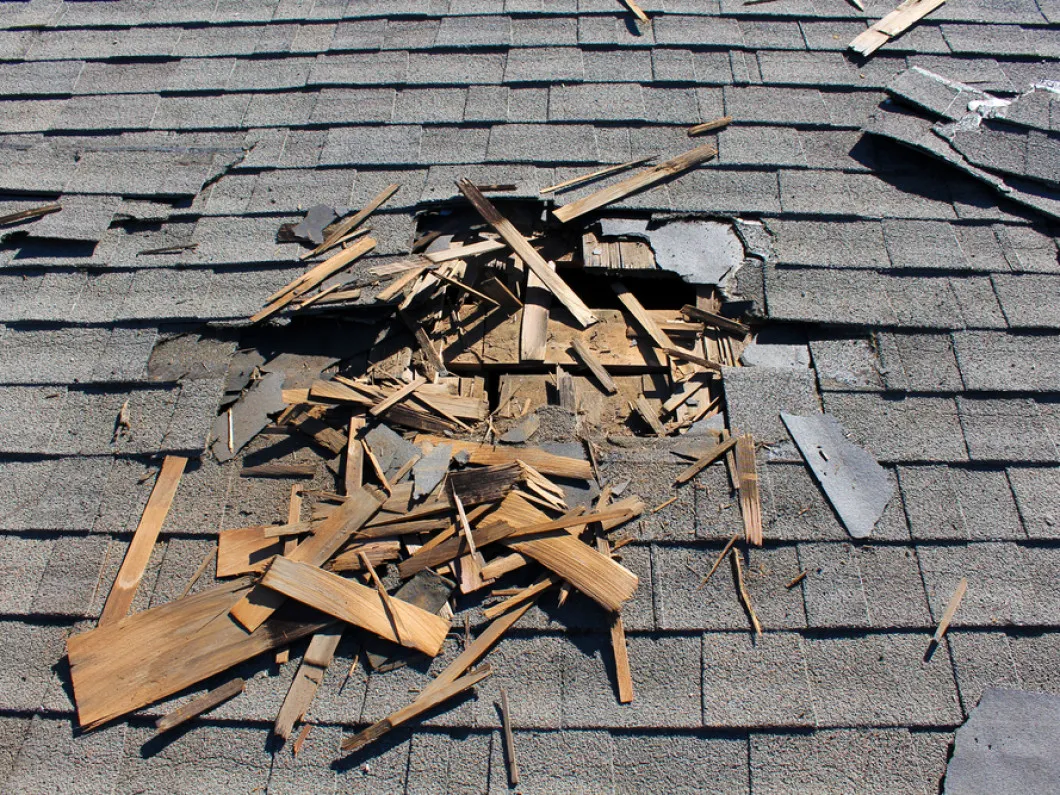
If water is coming in now, contain it first and call a roofer second. The steps below take about ten minutes and limit the damage while you wait.
What should I do right now if my roof is leaking?
Here is what to do in the first minutes of a leak:
- Put a bucket under the drip and move furniture and electronics away.
- If the ceiling is bulging, poke a small hole at the lowest point so the water drains into the bucket instead of spreading.
- Turn off power to any light fitting or outlet that is getting wet.
- If you can reach the attic safely, put a container under the wet spot there.
- Take photos and video of the leak and the damage.
- Call us at (425) 522-5354. Stay off the roof. A wet, mossy roof is very slippery.
Why does my roof leak only in heavy rain or wind?
A leak that shows only in heavy rain or wind usually comes from a spot that ordinary rain never reaches. Wind pushes water sideways and uphill: under lifted shingles, behind wall and chimney flashing, into ridge and gable vents and around skylights. Bellevue's fall storms come mostly from the south, so these leaks often appear on the south and west sides. A valley or gutter packed with fir needles can also overflow backward under the roofing in a downpour.
Why is there a water stain on my ceiling but no drip?
A stain on the ceiling with no drip means a small amount of water is getting in, soaking into the insulation and drywall and drying out between rains. It can be a slow roof leak. In winter here it can also be attic condensation, or a bath fan duct that has come loose and is blowing damp air into the attic. Each has a different fix, so the attic needs to be looked at before anything is patched.
How do roofers find where a leak starts?
We find a leak by working uphill from the stain. Water runs along rafters and decking before it drops, so the entry point is often several feet from the drip. We check the attic for stains and wet wood, then check everything above that spot on the roof: flashing, pipe boots, nail pops, valleys and skylights. When it is dry, a controlled test with a hose, one area at a time, can confirm the source.
Can a roof be repaired in the rain or in winter?
Temporary repairs, yes. Permanent ones usually need a dry spell. A tarp or an emergency patch can go on in the rain to stop the water. Sealants, shingle seal strips and membrane adhesives bond poorly to wet surfaces, so the lasting repair waits for a dry window. Bellevue winters are mild and those windows come often enough that winter repairs are routine.
Do you do emergency roof repair?
Call us at (425) 522-5354. We do our best to get a crew out quickly to stop the leak and protect the building. After a major wind storm many homes call at once, so get in touch as early as you can. HomeGuide puts the national emergency surcharge at $200 to $300 on top of the repair itself.
The leak came back after another roofer fixed it. What now?
A leak that came back usually means the first repair treated the wrong spot or only the symptom. A bead of caulk over old flashing is the classic case. It holds for one season and then cracks. Call the first roofer and ask them to make it right if they gave a workmanship warranty. If you want a second look, we trace the leak from the attic up, show you photos of the true entry point and quote a proper repair.
Is a small leak really urgent?
Yes. A small leak does its damage out of sight. With rain most days from October to April, the wood never gets a chance to dry. Insulation gets soaked, decking rots and mold starts on the underside of the sheathing. A repair that would have been minor in October can involve new decking and drywall by spring.
Can a leaking roof cause mold?
Yes. Mold grows on damp wood, drywall and insulation, and it can start within days of them getting wet. In Northwest attics, mold on the sheathing also comes from condensation and poor ventilation with no roof leak at all. Stopping the water is the first step. If the moldy area is large, a mold remediation company should handle the clean-up. That is separate work from roofing.
Why is my skylight leaking?
A skylight leaks for one of three reasons. The flashing around it has failed, the seal in the skylight itself has failed, or it is not a leak at all but condensation dripping from cold glass. Needles and debris piled against the uphill side hold water there and speed up the first kind. Older skylights are often best replaced together with the roof. HomeGuide lists skylight leak repair at $225 to $800 and skylight replacement at $800 to $2,400 nationally.
Water is coming through a light fixture. Is that dangerous?
Yes. Water in a light fixture is a shock and fire risk. Do not touch the fixture or the switch if they are wet. Turn off the breaker for that circuit at the panel, and leave it off. Put a bucket underneath. The water has usually run along the ceiling to the fixture because the hole there is the easiest way out, so the roof entry point may be some distance away. Have an electrician check the fixture and wiring before the power goes back on.
Why is my ceiling leaking when it has not rained?
A ceiling that leaks when it has not rained is often not a roof leak. Common causes are condensation dripping in the attic after a cold night, a bath fan duct full of water, a plumbing pipe or a furnace or air conditioning drain line above the ceiling. Wet moss and needles can also hold water and release it slowly for a day or two after rain. Note the time and the weather when it drips. That pattern points to the source.
Why is the attic dry right above the stain?
The attic is often dry directly above the stain because the water came in somewhere else. It runs down the underside of the decking or along a rafter, then drops onto the ceiling lower down the slope. Insulation can also soak it up and hide the trail. Another reason is timing: the wood has dried since the last rain. Look uphill from the stain for dark tracks on the wood, rusty nail tips and matted insulation.
Is it normal for a new roof to leak in the first year?
No. A new roof should not leak at all in its first year. When one does, the cause is almost always a detail of the installation: flashing at a wall or chimney, a pipe boot, a skylight, a valley or an exposed nail. The first wind-driven rain of fall is what finds it. Call the roofer who installed it right away, in writing, with photos. A leak this early is what a workmanship warranty is for.
A free roof inspection with photos and a written quote is the only way to get a real price for your roof. Call or text The Bellevue Roofers at (425) 522-5354.